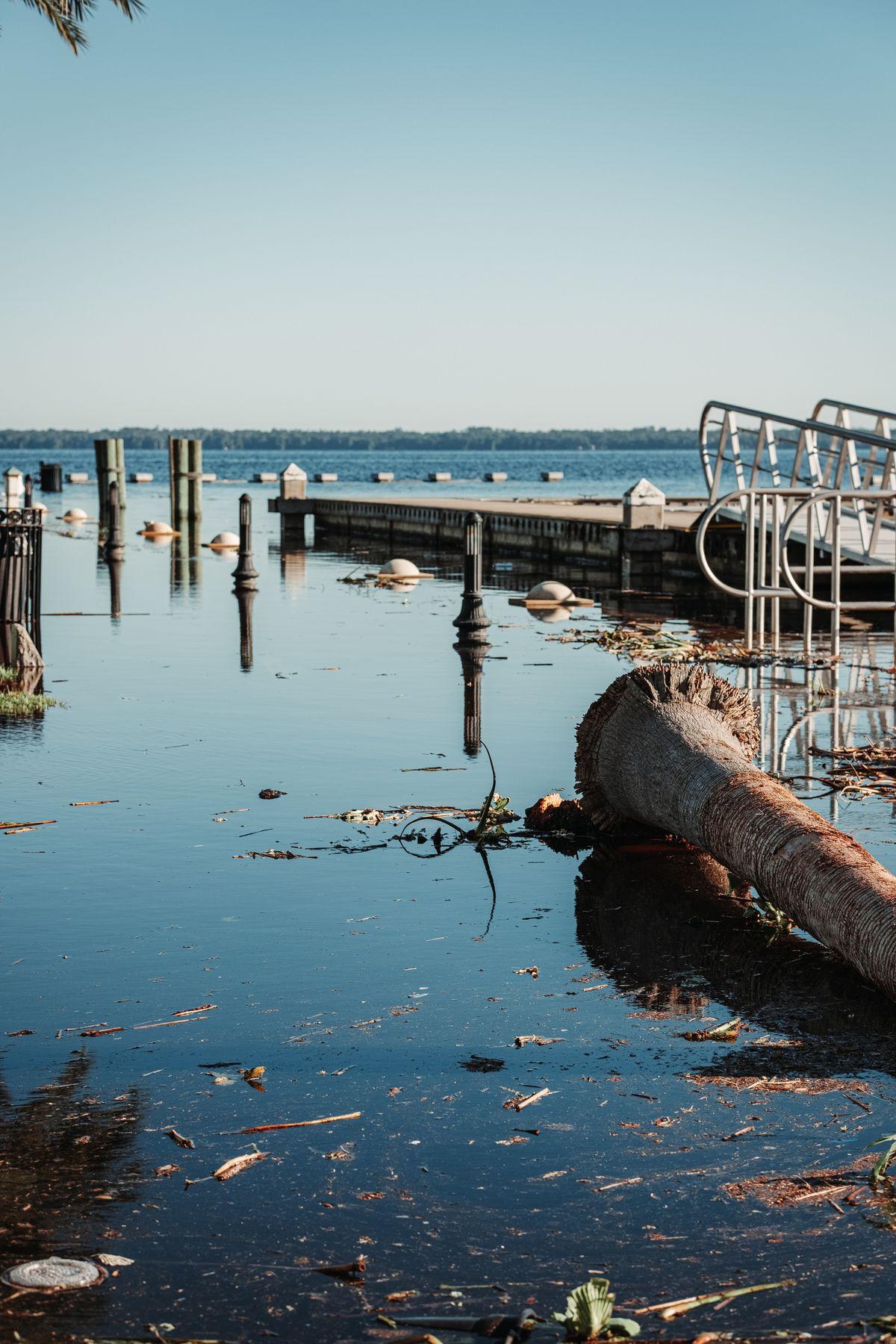
The most dangerous dock on the First Coast is the one that looks fine the morning after a hurricane. Storm surge does its worst work below the waterline, scouring away the bottom material that holds pilings in place, and it leaves no trace on the deck above. Owners walk out to check for damage and put their full weight on a structure that has lost much of its support.
This guide covers what to do after a storm, in the order that keeps you safe and protects your insurance claim. The sequence matters as much as the content — documentation done after cleanup is worth a fraction of documentation done before it.
Step one: assess from shore, and stay off
Before anything else, stand on solid ground and look at the whole structure. You are looking for changes in geometry rather than obvious damage, because geometry is what reveals hidden failure.
- Is the deck plane still level, or does it dip, tilt, or sit lower than you remember?
- Are the pilings still vertical and evenly spaced, or has any one leaned or shifted?
- Is the dock still square to the shore, or has the frame racked into a parallelogram?
- Are there new gaps between members, or bolts standing proud of the wood?
- Does the walkway meet the shore or seawall at the same height it did before?
Any yes to a change in geometry means the dock is unsafe until a professional evaluates it. A dock that has moved has told you its supports moved, and there is no way to judge remaining capacity by eye. Every season after a storm, Florida sees injuries from owners inspecting docks that failed underneath them.
The other shore-side hazards
Treat every downed line near the water as live. Assume the water contains submerged debris, displaced pilings, and sharp metal. Watch for wildlife displaced by surge — snakes and alligators relocate during flooding and are commonly found around waterfront structures for days afterward. And if there is any fuel sheen on the water, keep away and report it.
Step two: photograph everything before you touch anything
This is the step owners rush past and later regret. Insurance claims for dock damage turn almost entirely on evidence, and the most contested question in any dock claim is which damage the storm caused and which was pre-existing wear. Photographs taken before cleanup are the strongest answer available.
- Shoot wide establishing shots of the whole structure from several angles on shore, including the shoreline and seawall.
- Shoot medium shots of each damaged section, framed so the damage is clearly located within the structure.
- Shoot close-ups of specific failures: broken members, sheared bolts, split pilings, displaced decking.
- Photograph debris in place before removing any of it, including where it came to rest.
- Capture the boat lift separately, including the cradle position, cables, and motor housing.
- Take video walking the shoreline, narrating what you are seeing and the date.
- Confirm your device is recording date and location metadata, and back everything up off the phone immediately.
If you took pre-storm photographs — which is the core recommendation of any hurricane dock preparation routine — pair them with these now. A before-and-after set from the same angles is close to unarguable.
Step three: the structural assessment
Once the dock has been cleared as safe to walk, or once a professional is with you, the assessment works from the bottom up. That order matters because failures at the bottom explain symptoms at the top, and diagnosing from the deck down produces wrong conclusions.
Pilings and the bottom
Pilings first, always. Look for new leaning, rotation, or vertical movement — a piling that has been driven further down or lifted will show a change in where the cap sits on it. Check the mudline at low tide for scour: fresh erosion around a piling base means embedment has been lost, and the piling now carries its load with less holding capacity than it was designed for. Scour is the single most consequential storm effect on a dock and the least visible.
Look also for impact damage. Surge carries debris, boats, and detached structures at speed, and a strike can split a piling or shear it without leaving obvious surface evidence above water.
Framing and connections
Next, the substructure. Sight down stringers for new sag or twist. Check every accessible bolt and bracket for shearing, elongated holes, or fasteners that have pulled through the wood. Storm loading works connections hard, and a bolt hole that is now oval rather than round is a connection that has permanently lost its grip.
Cross bracing deserves particular attention, because bracing is what resists racking and it is the first thing sustained wind attacks. A brace that is loose, split at its ends, or missing entirely explains any racking you observed from shore.
Decking and surface
Missing, lifted, or shifted boards are the visible layer and the least structurally urgent, but they are diagnostic: uplift damage that starts at one board and peels outward tells you wind got underneath the deck surface, which points back to how the decking was fastened.
Boat lift
Do not operate a storm-exposed lift until it has been inspected. Check the frame for plumb and any bending at the legs, inspect cables along their full length for kinks, birdcaging, or broken strands, and look at the motor and control box for water intrusion. A lift that has been submerged needs its motor and electrical assessed before it is powered up, and running a damaged cable under load is how a lift failure becomes a dropped boat. This is boat lift repair territory, not a DIY reset.
Seawall and shoreline
Check the seawall cap for new cracking, look for soil voids or sinkholes in the yard behind the wall, and note any section that has bowed or tilted seaward. Voids behind a wall mean fill is washing out through it, and that progresses quickly. Because dock pilings and seawalls often share the same scour problem, a dock that moved and a wall that shifted are usually one issue rather than two.
Step four: the insurance claim
Florida homeowner policies treat docks, boat lifts, and other detached water structures very differently from the dwelling, and many owners learn their actual coverage for the first time after a storm. Some policies exclude them entirely; others carry separate limits or a distinct deductible. Surge damage in particular is often a flood question rather than a windstorm question, and the two may sit with different carriers.
- Notify your carrier promptly — policies commonly have notification windows, and the claim queue after a regional event is long.
- Submit your photo and video documentation with the initial claim rather than waiting to be asked.
- Include your pre-storm photos and any prior inspection reports, which establish the dock's condition before the event.
- Keep receipts for emergency stabilization and debris removal; these are frequently reimbursable.
- Get a written contractor assessment describing the damage and its cause. An adjuster's report and a marine contractor's report often differ, and having yours matters.
- Do not sign an assignment of benefits, or authorize any repair, before you understand the scope and your coverage.
A warning about post-storm solicitation
After every major Florida landfall, crews appear door to door offering immediate repairs, often with paperwork that assigns your insurance benefits to them. Some are legitimate contractors expanding capacity. Many are not. Verify any contractor's license and insurance directly with the Florida DBPR, insist on a written scope, and never pay substantially up front. The pressure to act fast is exactly what the fraud depends on.
Step five: emergency stabilization versus permanent repair
These are different projects and should be quoted separately. Emergency stabilization makes a structure safe and prevents further loss — bracing a leaning piling, removing a hanging section, securing debris. It is fast, relatively inexpensive, and generally proceeds without the permitting that permanent work requires.
Permanent dock repair comes after, once the full scope is understood and the claim is settled. Resist combining them under time pressure. A permanent repair scoped in the chaos of the first week is often scoped wrong, and after a regional storm event the contractor queue means you will be waiting regardless.
What storm damage looks like across the First Coast
Damage patterns follow exposure. Ocean-influenced and inlet-adjacent docks around Amelia Island, Fernandina Beach, Jacksonville Beach, Vilano Beach, and Flagler Beach take wave impact and the most severe scour, so piling movement leads the list there.
Intracoastal docks through Ponte Vedra Beach, Palm Valley, and Crescent Beach see debris impact as a leading cause, because surge moves everything upstream and down through a confined channel. Canal docks in Palm Coast and the beaches communities most often show uplift damage — surge rises in confined water and lifts decking and lightly-secured structures from below.
And along the St. Johns River through Jacksonville, Orange Park, and Fleming Island, recent storms have pushed surge far upriver to docks whose owners had long considered themselves inland. If your dock has never been assessed for storm damage because you assumed distance from the ocean protected it, that assumption is worth retiring.
Get a professional assessment
A visual inspection from a kayak catches perhaps half of what a storm does to a dock. Scour, borer damage exposed by shifted material, and compromised embedment all sit below the waterline where a professional dock inspection with underwater assessment is the only way to see them. It also produces the written report that makes an insurance claim work.
If a storm has come through your part of the First Coast, describe what you are seeing and we will connect you with a licensed marine contractor for a free, no-obligation assessment. Get in the queue early — after a regional event, the wait only grows.