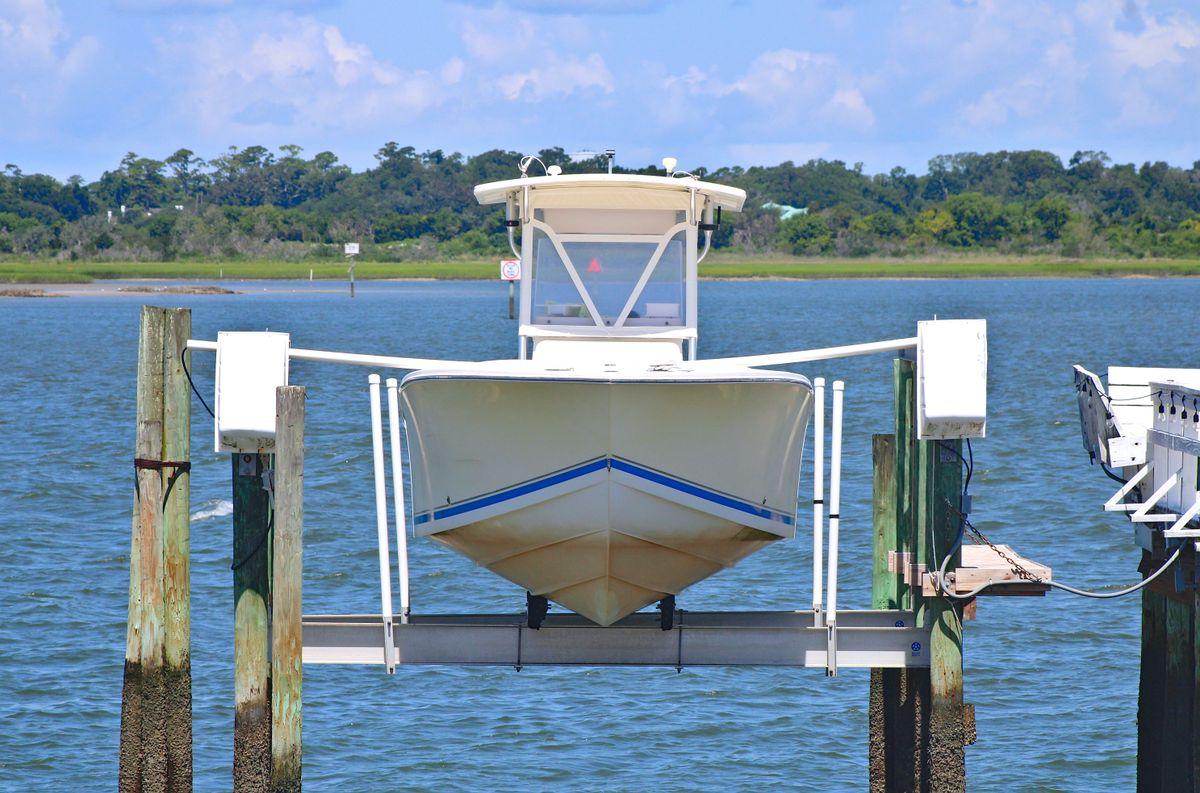
Boat Lift Repair
A boat lift that's slow, uneven, or making noise is telling you something specific — and catching it early is almost always cheaper than an emergency repair after a cable fails with your boat in the air.
Boat Lift Repair in Northeast Florida
Boat lifts fail progressively, and the early symptoms are specific if you know how to read them. A lift that rises unevenly is telling you a cable has stretched or a drive is out of sync. A motor that hums without turning is usually a failed start capacitor — a modest repair — not a dead motor. A lift that won't stop at the right height needs limit switch adjustment before it needs anything else. Reading the symptom correctly is most of the diagnosis, and it's the difference between a $150 fix and an unnecessary $2,000 parts swap.
Cables are the wear item that matters most, because they're the failure with real consequences. Galvanized lift cable in brackish First Coast water has a working life of roughly three to five years; visible rust, fraying, or flattened strands mean replacement now, not at the end of the season. A cable that parts under load drops the boat — into the water at best, onto a piling or bunk frame at worst — and the resulting hull damage costs many multiples of the cable that would have prevented it. During any cable service we also inspect sheaves and pulleys, since a grooved or seized sheave chews through new cable prematurely.
Beyond cables and electrics, the honest repair list runs through bunks and structure. Bunk boards and carpet rot and wear where the hull rests, and failed bunks concentrate load on small patches of hull — replacement restores proper support and protects gelcoat. Gearboxes and drive units want lubrication and seal attention before they want replacement. And when a lift feels loose as a whole, the problem is often the supporting pilings rather than the machinery; we check structure on every repair visit because a perfectly tuned lift on a failing piling is still a failing lift.
We service all the major lift brands found on First Coast docks, and the pattern across all of them is the same: components addressed at the first symptom cost a fraction of components run to failure. If your lift is doing anything it didn't do last season — new sounds, new hesitation, new drift — that's the moment a repair is cheapest.
Signs You Need Boat Lift Repair
- The lift rises unevenly on one side
- Cables are frayed, rusted, or visibly worn
- The motor strains, smokes, or runs unusually slow
- Bunks or cradle pads are cracked, waterlogged, or the carpet is worn through
- Pilings supporting the lift are loose or leaning
- The lift doesn't stop at the right height (limit switch out of adjustment)
- The remote control is unreliable or stops responding
- The motor hums but won't start (often a failed capacitor)
How It Works
- 1Diagnosis
We inspect cables, motor, gearbox, drive components, and supporting structure to find the root cause.
- 2Repair estimate
You get a clear breakdown of what needs replacement versus what's still serviceable.
- 3Repair
We replace worn components with marine-rated parts matched to your lift's make and capacity.
- 4Load test
We test the repaired lift under load before we consider the job complete.
Why Invest in Boat Lift Repair
- Prevents a small issue from becoming a dropped-boat emergency
- Extends the service life of an otherwise sound lift
- Restores even, safe lifting operation
What It Costs
- Cable replacement vs. motor or gearbox repair
- Bunk board and carpet replacement
- Limit switch adjustment or replacement
- Capacitor replacement
- Remote system troubleshooting or replacement
- Lift brand and part availability
- Whether supporting pilings also need work
Boat Lift Repair Near You
Boat Lift Repair Questions
Get a Free Boat Lift Repair Estimate
Get matched with local contractors serving all of Northeast Florida.