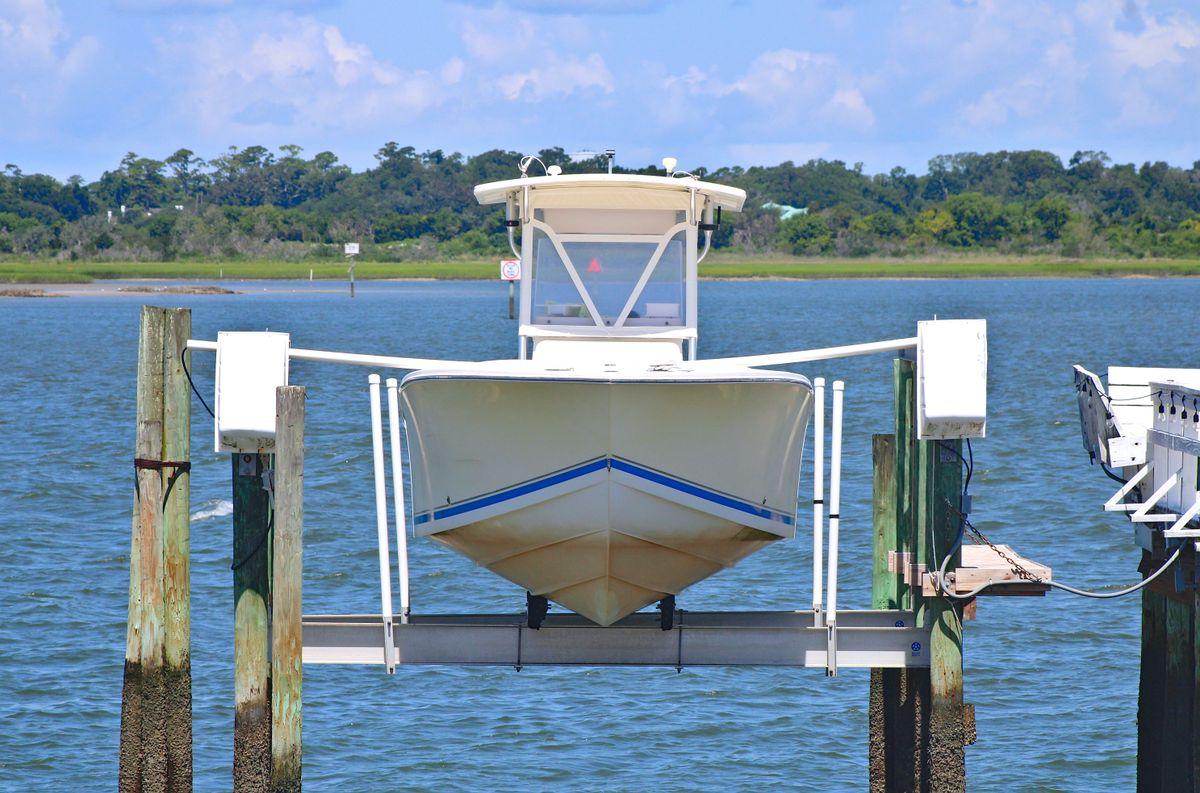
Boat Lift Motor Replacement
A failing lift motor rarely announces itself loudly — it's usually a slow drift into straining, overheating, or tripping breakers before it quits altogether. We match replacement motors to your lift's exact torque and voltage requirements.
Boat Lift Motor Replacement in Northeast Florida
Lift motors on Northeast Florida docks lead hard lives: salt air, rain, load spikes, and long idle periods between cycles. Most give seven to twelve years before the symptoms start — running hot, tripping breakers, straining under loads they used to handle easily, or the classic hum-without-turning that usually means a failed start capacitor rather than the motor itself. Part of an honest motor call is ruling out the cheaper causes first: capacitors, switches, and low dockside voltage all imitate a dying motor at a fraction of the replacement cost.
When the motor genuinely is done, matching the replacement correctly matters more than brand loyalty. The new unit has to match the drive's torque requirements, the lift's capacity class, and the dock's power supply — and its wiring should come up to current marine electrical standards during the swap, with GFCI protection and enclosures rated for the environment. An underspecced motor will move the lift on calm days and then fail exactly when a loaded boat and a hot afternoon stack against it; a correctly matched one disappears into the background for another decade.
Replacement day is also the right moment to service everything the motor touches. With the drive opened up, gearbox lubrication, sheave condition, cable wear, and contact corrosion can all be addressed for minimal added labor. We treat motor swaps as a drive-system service rather than a part swap, because sending a new motor to work against a worn gearbox or seized sheave just transfers the failure downstream.
Owners can extend the next motor's life with two cheap habits: keep a cover on it (sun and rain are the top killers of dockside motors), and cycle the lift periodically during long idle stretches so seals and windings don't sit static through months of salt-air humidity.
Signs You Need Boat Lift Motor Replacement
- The motor runs hotter or louder than usual
- The lift trips breakers or stalls partway through a cycle
- The motor has visible water intrusion or corrosion
- The lift no longer holds position reliably
How It Works
- 1Diagnosis
We confirm the motor — not the switch, cable, or gearbox — is the actual point of failure.
- 2Motor matching
We select a replacement rated for your lift's specific capacity and voltage requirements.
- 3Installation & wiring
We install and wire the new motor to current electrical code for wet marine environments.
- 4Function test
We run the lift through a full cycle under load before completing the job.
Why Invest in Boat Lift Motor Replacement
- Restores reliable, full-cycle lift operation
- Correct motor matching prevents repeat premature failure
- Wiring brought up to current marine electrical code during the swap
What It Costs
- Motor horsepower and voltage
- Wiring condition and code compliance needs
- Accessibility of the motor mount
Boat Lift Motor Replacement Questions
Get a Free Boat Lift Motor Replacement Estimate
Get matched with local contractors serving all of Northeast Florida.