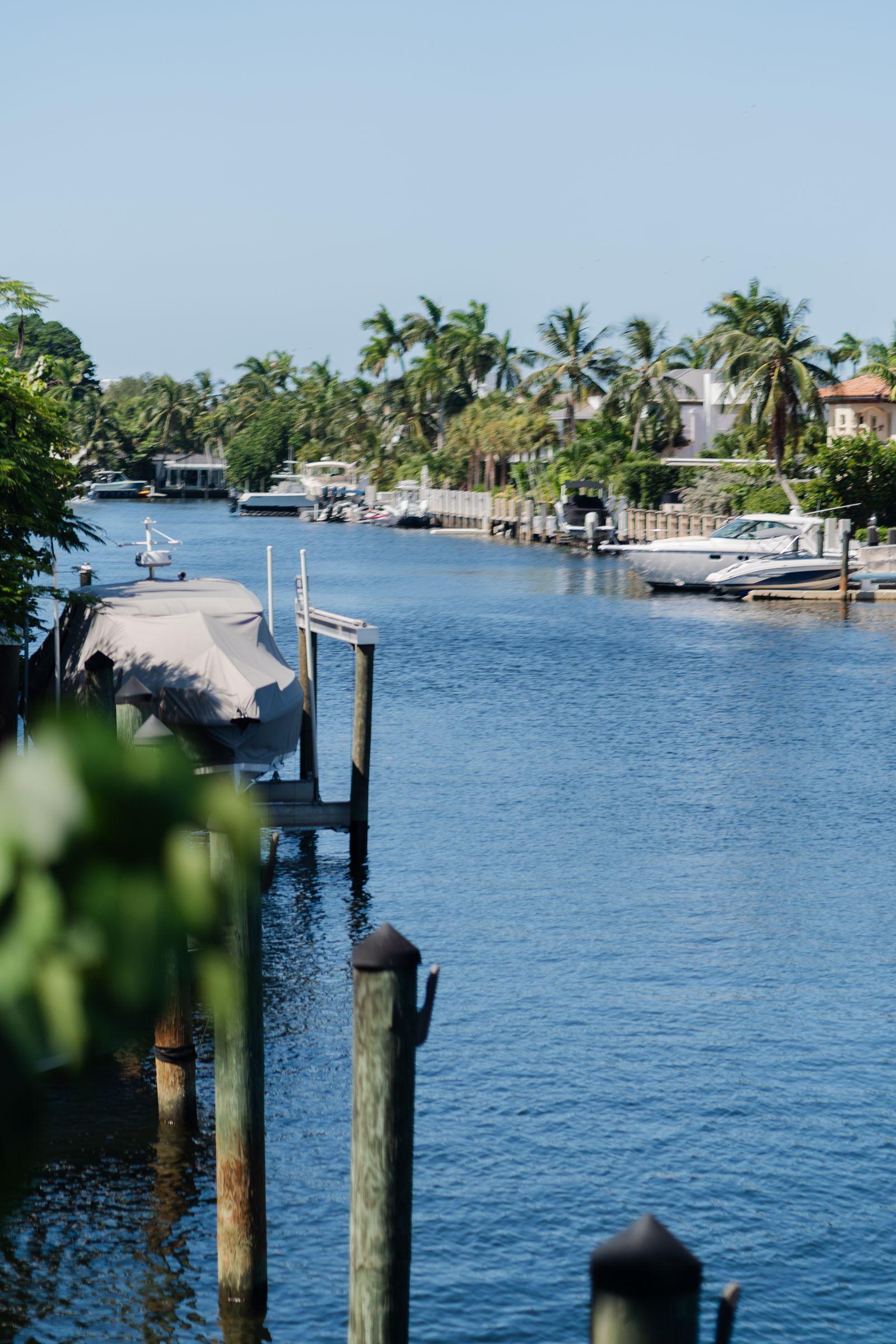
A dock built inland on a freshwater lake and an identical dock built on the Intracoastal near Ponte Vedra Beach will not age the same way. Give them fifteen years and the lake dock will look tired. The saltwater dock, without maintenance, may be structurally finished.
That difference is not one process. Salt water attacks a dock on five separate fronts at once — electrochemical, biological, mechanical, and photochemical — each working at a different rate on a different material in a different part of the structure. Owners who understand which front is winning where can spend maintenance money precisely instead of generally, and that alone is worth several years of dock life.
Front one: metal corrosion
Salt water is an electrolyte, which means it turns any piece of metal in it into a small battery. Iron gives up electrons, dissolves into solution, and reappears as rust. This process runs roughly five times faster in salt water than in fresh, and faster still in the splash zone, where oxygen is abundant and salt concentrates as water evaporates between wettings.
Northeast Florida sits in a particularly aggressive band for this. Water in the Intracoastal, the tidal reaches of the St. Johns, and the inlets at St. Augustine and Fernandina Beach carries enough salinity to drive full marine corrosion rates, and year-round warmth means the reaction never slows the way it does in northern waters. There is no dormant season here.
Why galvanized hardware eventually loses
Hot-dip galvanizing works by sacrifice: the zinc coating corrodes preferentially so the steel underneath does not. It is genuinely effective, but it is a consumable. Once the zinc in a given area is spent, the steel beneath begins to go, and it goes quickly. In practice, quality galvanized fasteners on a First Coast saltwater dock deliver somewhere in the range of 10 to 20 years before their holding strength is meaningfully compromised — less in the splash zone, less on a dock in an inlet with high flow.
The visible warning is rust bleed, those orange or black streaks running down from a bolt head. By the time streaking is obvious, the fastener has been sacrificing itself for years and a hidden portion of its shank is already gone.
The galvanic acceleration nobody plans for
Put two different metals in contact in salt water and the corrosion of the less noble one accelerates dramatically. Stainless fasteners through galvanized brackets, or steel bolts in aluminum lift hardware, will eat one member far faster than either would corrode alone. This is the most common self-inflicted damage on First Coast docks, and it almost always traces to a partial repair using whatever hardware was available rather than what was already in the structure.
Front two: fastener failure as a structural event
It is worth separating this from general corrosion because the consequence is different. A dock is not held together by its lumber; it is held together by a few hundred bolts, lags, screws, and brackets. When those go, the structure comes apart while every piece of wood in it is still sound.
Corrosion also damages the wood around the fastener. Rust occupies more volume than the steel it came from, so a corroding bolt expands inside its hole, splitting the wood and enlarging the opening. The connection loosens as the fastener weakens — two failure modes progressing together, which is why loose hardware on an old saltwater dock is rarely fixed by simply tightening it.
Going over every accessible fastener once a year, snugging what is loose and replacing what is streaking, is the highest-return hour of maintenance available on a saltwater dock. It costs almost nothing and it addresses the failure mode most likely to actually take the dock down.
Front three: marine borers
This is the front that has no equivalent in fresh water, and the one that does the most damage out of sight. Two families of marine organisms consume submerged wood: shipworms, which are actually mollusks that tunnel through the interior, and gribbles, small crustaceans that erode the surface layer.
Shipworm damage is insidious because the entry holes are pinhead-sized while the tunneling inside can be extensive. A piling can be substantially hollowed out and still present a normal-looking exterior. Owners discover shipworm damage when a piling fails under load or when a contractor probes it during inspection — rarely by looking at it.
Borer activity on the First Coast tracks salinity closely. The high-salinity water near the inlets — Mayport, the St. Augustine Inlet, Matanzas — supports the most aggressive populations. Farther up the St. Johns toward Orange Park, Fleming Island, and Green Cove Springs, salinity drops enough that borer pressure eases considerably, which is one of the genuine advantages of upriver frontage. Pressure treatment for marine use is the primary defense, which is why treatment retention level on pilings is a specification worth insisting on rather than assuming.
Front four: marine growth and biofouling
Barnacles, oysters, algae, and slime colonize everything in the tidal zone. The direct damage is modest, but the indirect effects are real. Growth adds weight and increases the surface area exposed to current and wave force, which raises the mechanical load on the structure. It holds moisture against wood permanently, sustaining the conditions rot needs. And barnacle and oyster attachment physically scores the surfaces they grow on, opening pathways into treated wood.
The most immediate cost is safety. Algae and slime on decking in shaded or low-freeboard areas creates a surface that is genuinely treacherous wet. Docks in the slow-exchange canals around Jacksonville Beach, Neptune Beach, and Atlantic Beach grow it fastest, because low water turnover in a dead-end canal is exactly what fouling organisms want.
Periodic dock cleaning handles this, but pressure matters — excessive pressure on pressure-treated lumber strips the softer early wood, raises the grain, and opens the surface to faster moisture uptake. Cleaning a dock aggressively enough to look new can shorten its life.
Front five: UV and thermal cycling
Florida sun degrades the lignin binding wood fibers together, which is why untreated decking silvers, checks, and splinters. UV also embrittles plastics and breaks down the resins in older composite products, and it is why dock lighting housings, cable jackets, and lift control boxes fail on the First Coast years earlier than their rated life.
Alongside UV runs daily thermal cycling. Decking that hits high surface temperatures in afternoon sun and drops sharply after a summer thunderstorm expands and contracts continuously, working fasteners loose and widening the checks that UV opened. Those checks then hold water, and the cycle feeds itself.
The realistic timeline
For a well-built pressure-treated dock on First Coast salt water, with reasonable maintenance, the sequence tends to run roughly like this.
- Years 1-3: Surface weathering and graying. Growth establishes in the tidal zone. Nothing structural.
- Years 3-7: First fastener corrosion appears as rust bleed at exposed connections. Decking begins to check and cup. Borer activity is underway but invisible.
- Years 7-12: Galvanized fasteners in the splash zone approach the end of useful life. Joist tops begin showing decay at deck board contact lines. Piling section loss becomes measurable at the tide zone.
- Years 12-20: Structural decisions arrive. Decking replacement is typically due, framing repair is common, and pilings need honest assessment. Docks that received annual fastener attention are in visibly better shape than those that did not.
- Years 20-30: Well-maintained docks with sound pilings can continue with periodic component replacement. Neglected docks are usually at rebuild.
The variable that moves this timeline most is not construction quality or material grade. It is whether anyone touched the hardware. Two identical docks diverge by five to ten years of service life on that alone.
A maintenance schedule that matches the threats
Every few months
- Rinse decking and hardware with fresh water, especially after heavy spray or a storm. Removing surface salt before it concentrates is the simplest corrosion control there is.
- Clear growth from walking surfaces before it becomes a slip hazard.
Annually
- Go over every accessible fastener: snug what is loose, replace what is streaking, and match the metal already in the structure.
- Probe joist tops and piling tide zones with a screwdriver for soft wood.
- Reseal wood decking if you are running a sealed finish.
- Service the boat lift, including cable inspection — see boat lift maintenance.
- Photograph the dock for your records. This is what makes storm claims work.
Every three to five years
- Get a professional dock inspection, including underwater assessment of pilings for borer damage and scour.
- Evaluate remaining life on decking and framing together rather than separately.
How this varies along the First Coast
Salinity is the master variable, and it changes considerably across a fairly short stretch of coast. Docks near the inlets at Fernandina Beach, Mayport, St. Augustine, and Matanzas see the highest salinity, the strongest borer pressure, and the fastest hardware corrosion — those owners should treat the annual fastener pass as non-negotiable.
Intracoastal frontage through Palm Valley, Vilano Beach, and Crescent Beach adds constant wake to full-strength salt water, so mechanical loosening compounds the chemistry. Canal docks in the beaches communities trade wave energy for biological pressure. And upriver St. Johns properties around Orange Park, Fleming Island, and Green Cove Springs get a genuine reprieve on borers thanks to lower salinity, though brackish water still works steadily on fasteners.
The takeaway
Salt water will win eventually. The question a dock owner is actually answering is how long that takes and how much it costs along the way, and the levers are unglamorous: rinse the salt off, replace corroding hardware before it fails, keep growth off the wood without blasting the wood, and get eyes on the pilings every few years.
If it has been more than three years since anyone looked at your dock properly — particularly below the waterline, where borers and scour do their work unseen — that is the place to start. Tell us about your dock and we will connect you with a licensed First Coast marine contractor for a free assessment, with no obligation.