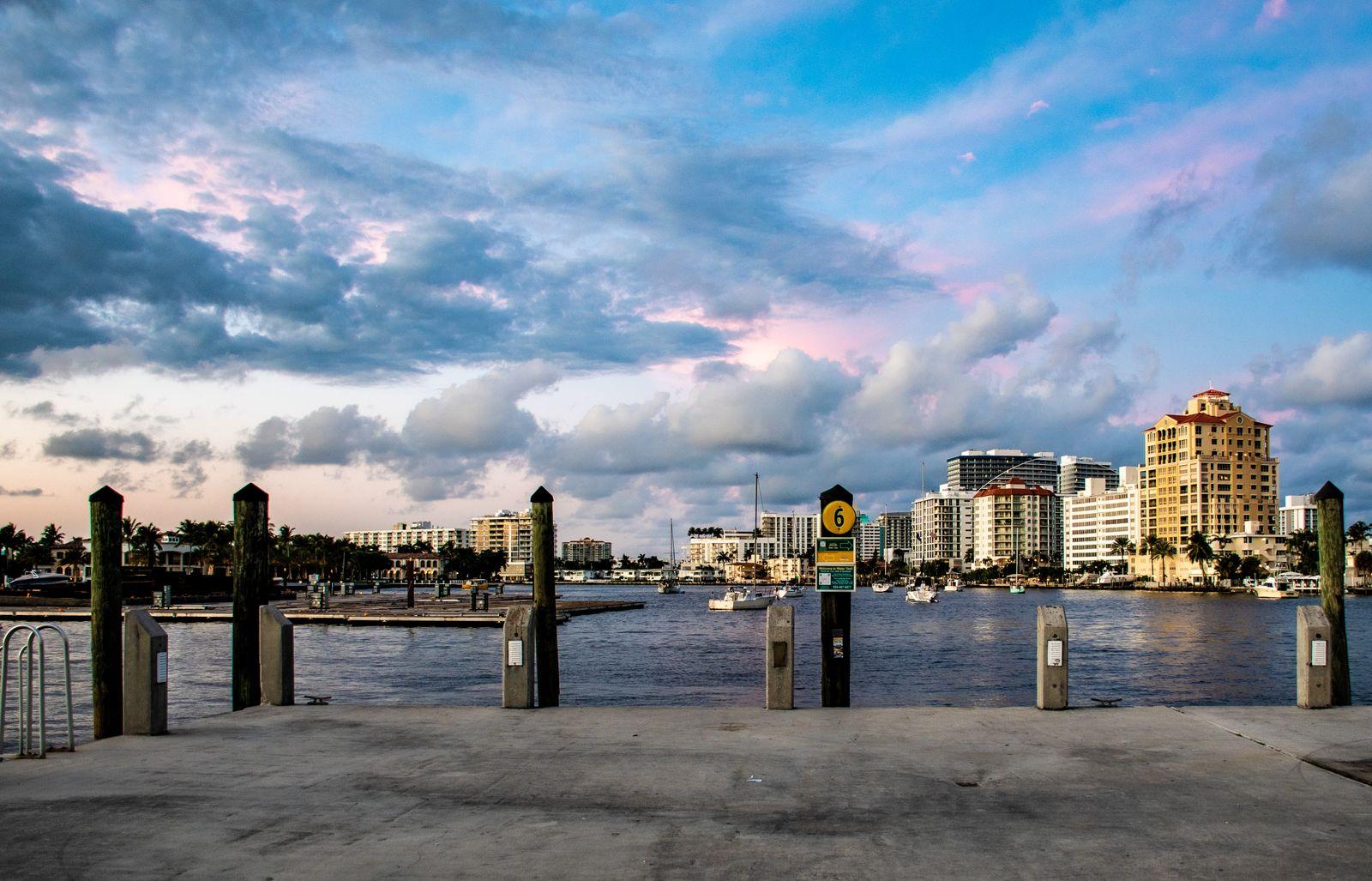
Every decision about a dock eventually comes back to its pilings. Decking is a wear surface. Framing is replaceable. Pilings are the dock, and they set the ceiling on what any repair above them is worth. Spending twenty thousand dollars on a new deck and frame supported by pilings with six years left is the most common expensive mistake in this trade.
So the useful question is not how long a dock lasts, but how long its pilings last — and in Northeast Florida water, the honest answer varies more by location than by material.
What kills a piling
Four processes, working at different depths on the same piece of wood.
The tidal splash zone
This is where most wood pilings actually fail — not underwater, and not up in the dry air, but in the band that is wet and dry twice a day. Repeated wetting and drying concentrates salt in the wood and holds moisture content in the range decay fungi thrive in, while abundant oxygen keeps the process running. Look at old pilings anywhere on the First Coast and you will see the same shape: a visible narrowing, sometimes an hourglass, right at the tide line.
That narrowing matters more than its size suggests, because bending stress on a piling peaks near the waterline. Section loss is happening precisely where the piling can least afford it.
Marine borers
Below the waterline, shipworms tunnel through the interior and gribbles erode the surface. Shipworm damage is the dangerous version because entry holes are pinhead-sized while the internal tunneling can be extensive — a piling can be substantially hollow and look entirely normal from outside. It is generally found by probing during a professional inspection, or by a failure.
Scour
A piling holds load through embedment — the depth of bottom material gripping it. Current, prop wash, and storm surge erode that material away, and a piling that has lost two feet of embedment carries its load with substantially less capacity even though the wood is perfect. Scour is invisible from the deck and is the leading cause of storm-time piling failure.
Mechanical fatigue
Wake, wind, and vessel contact flex a piling continuously. Over decades that works the connections at the cap loose and drives checking in the wood, which then admits moisture and organisms. Docks on high-traffic water — the Intracoastal through Palm Valley and Vilano Beach, the main St. Johns channel through Jacksonville — accumulate this faster than sheltered canal docks.
Wood pilings
Pressure-treated southern yellow pine
The default for residential docks across the First Coast, and for good reason: it is available, workable, drivable, and far cheaper than the alternatives. Realistic service life in Northeast Florida salt water runs roughly 15 to 30 years, and the spread within that range is enormous.
What determines where you land is treatment retention — the amount of preservative actually driven into the wood, measured in pounds per cubic foot. Pilings specified for marine use carry substantially higher retention than the ground-contact lumber sold for backyard projects, and in borer-active water that difference is the whole ballgame. A marine-retention piling near the St. Augustine Inlet might give 25 years; a general-purpose one in the same spot might give eight.
This is the single specification most worth insisting on in writing. When you request a quote for piling work, ask for the retention rating and the standard it is certified to, not just the phrase pressure-treated.
Tropical hardwoods
Greenheart and similar dense tropical species have natural borer resistance and can exceed 40 years in marine service. They are rare in residential First Coast work — expensive, hard to source, and difficult to work — but they turn up in older commercial and marina structures around Jacksonville and Fernandina Beach.
Concrete pilings
Prestressed concrete pilings are the long-life option, commonly delivering 50 years or more in Florida marine service. They are immune to borers and rot entirely, which removes the two processes that end most wood pilings.
They are not maintenance-free. Concrete in salt water fails through a specific mechanism: chloride penetrates the concrete cover, reaches the reinforcing steel, and corrodes it. The rust expands, and expansion cracks the concrete from the inside — the spalling you see on older seawall caps and bridge pilings. Adequate cover depth and good mix design push that out for decades, but poor-quality concrete work in a marine environment can fail faster than good wood.
Cost typically runs two to three times wood per piling, plus heavier equipment for handling and driving. On residential First Coast docks they make the most sense in high-value structures, in high-borer-pressure water near the inlets, or where the disruption of future piling replacement would be genuinely difficult. Commercial and marina work uses them as standard.
Composite and fiberglass systems
Fiberglass-reinforced polymer pilings and structural composite systems are immune to borers, rot, and corrosion, and manufacturers project 50-plus year service lives. The real-world track record in Florida is shorter than that projection simply because the products are newer, which is worth weighing honestly.
They are lighter than concrete and easier to handle, they do not leach preservative, and they suit environmentally sensitive locations well. Costs run comparable to or above concrete. The practical limitation is that they are less forgiving to drive in some bottom conditions and fewer local crews have deep experience with them, so availability varies across the region.
Piling wraps and sleeves: extending what you have
A wrap is a barrier — polyethylene, PVC, or a fiberglass jacket — sealed around the piling through the splash zone and below, cutting off the oxygen and water exchange that both decay and borers depend on. On a piling with sound remaining cross-section, wrapping can add 10 to 20 years for a fraction of replacement cost.
The critical judgment is whether the piling has enough structure left to be worth protecting. Wrapping a piling that is already substantially hollowed simply hides the problem behind a jacket, and it is genuinely harder to assess afterward. This decision needs a probe and a professional eye, not a visual guess.
Epoxy injection and structural sleeves — a form placed around the piling and filled with grout — sit between wrapping and replacement, restoring section to a piling with localized damage. They suit situations where a piling is compromised in a defined band but sound above and below.
When a piling needs replacing
- Any lean, rotation, or vertical movement relative to neighboring pilings
- Section loss beyond roughly a third of original diameter at the tide zone
- Hollow response when tapped, or a probe that penetrates deeply and easily
- Confirmed extensive borer tunneling
- Significant scour at the base that has reduced embedment
- Splitting that runs the length of the piling rather than surface checking
The one owners misread most often is a lean. A leaning piling is not just a compromised support — it is a support that has handed its load to its neighbors, which means the next failure is already being set up. Leaning pilings do not stabilize.
What piling work costs
- Piling wrap or sleeve: roughly $400-$1,200 per piling
- Epoxy injection or structural jacket repair: roughly $800-$1,800 per piling
- Wood piling replacement: roughly $1,200-$2,500 per piling
- Concrete piling replacement: roughly $2,500-$5,000 per piling
- Adding pilings for load or stabilization: roughly $1,500-$3,000 each
Depth, bottom composition, and access drive these more than anything else. Soft, silty bottoms — common along stretches of the St. Johns near Ortega and Avondale — require deeper driving to reach bearing. And a dock a barge can pull alongside is meaningfully cheaper to work on than one at the back of a shallow canal.
Once several pilings need replacement at once, request a dock rebuild comparison. The incremental cost of a full rebuild over a multi-piling repair is often smaller than owners expect, and it resets the whole structure's service life rather than extending part of it.
Lifespan across the First Coast
Salinity is the dominant local variable, and it shifts considerably across the region. Pilings near the high-salinity inlets at Fernandina Beach, Mayport, St. Augustine, and Matanzas face the strongest borer pressure in Northeast Florida, and wood there lives at the short end of its range unless treatment retention was specified properly.
Intracoastal frontage through Ponte Vedra Beach, Palm Valley, Vilano Beach, and Crescent Beach combines full salinity with constant wake and current-driven scour, so mechanical fatigue and embedment loss matter as much as biology. Upriver on the St. Johns through Orange Park, Fleming Island, and Green Cove Springs, lower salinity meaningfully reduces borer activity, and wood pilings there routinely reach the upper end of the range. Canal docks in Palm Coast and the beaches communities sit in calmer water, which slows scour, though poor exchange keeps decay pressure high in the splash zone.
Know what you are standing on
Most owners have never had their pilings assessed below the waterline, which means the most important component of the structure is the one they know least about. A dock inspection that includes underwater assessment is the only reliable way to learn whether you have twenty years of piling life left or three — and that answer should govern every other dock decision you make.
If you are weighing decking, framing, or a lift installation, get the pilings evaluated first. Tell us about your dock and we will connect you with a licensed First Coast marine contractor for a free, no-obligation assessment.