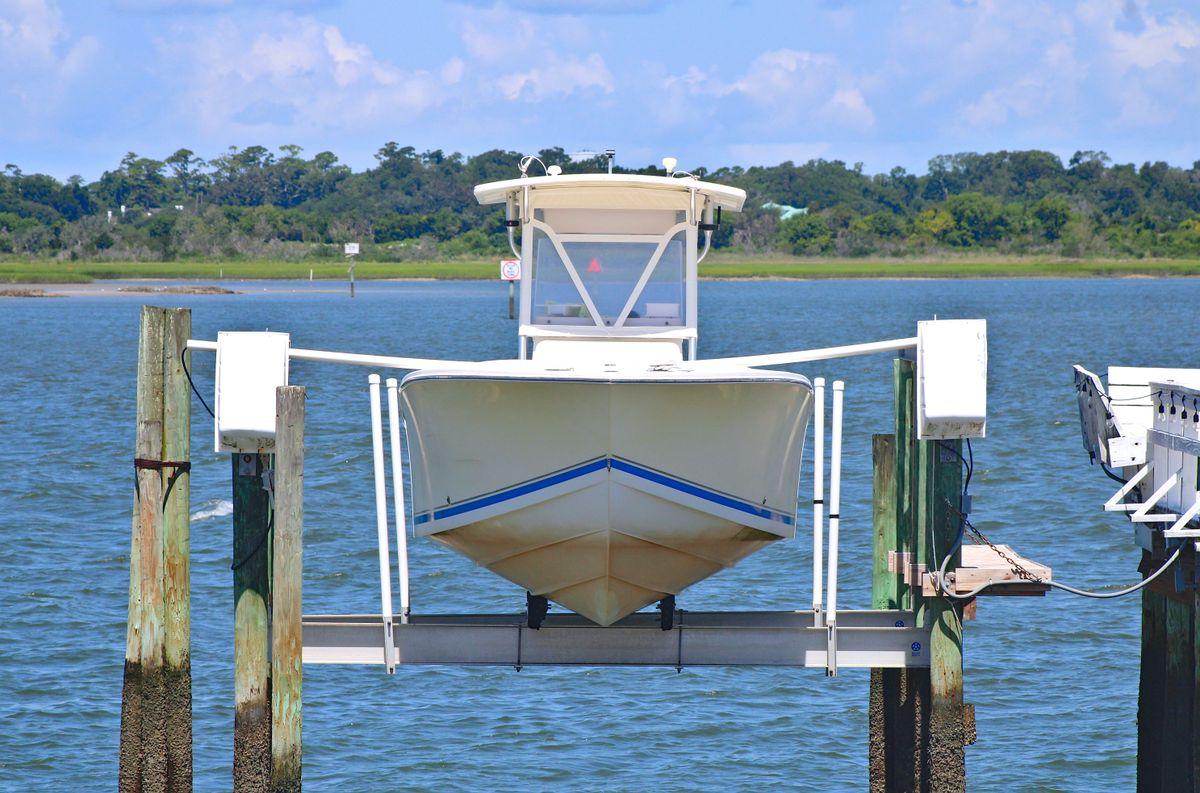
A boat lift is the least-maintained piece of expensive equipment on most First Coast waterfronts. Owners service their boats religiously and then ask a set of cables, a gearbox, and a motor mounted in salt spray to hold that boat twelve feet in the air, year after year, with no attention at all.
The failures that result are not subtle. A cable parts and a hull drops onto its bunks or into the water. A motor seizes with the boat suspended. A frame racks and the cradle jams half-raised. All of these are expensive, all of them are dangerous, and nearly all of them are preventable by a maintenance routine that takes a few hours a year.
Why Florida is harder on lifts than anywhere else
Three conditions compound here. Salt water corrodes steel roughly five times faster than fresh water, and a lift keeps its most critical components — cables, pulleys, motor, gearbox — permanently in the splash and spray zone. Year-round warmth means there is no dormant season in which corrosion slows. And First Coast lifts get used all twelve months, so cycle counts accumulate far faster than on a lift in a seasonal market.
The practical consequence is that manufacturer maintenance intervals written for general use are conservative for Florida salt water. A schedule that assumes annual service and seasonal downtime does not describe a lift in Jacksonville Beach or Ponte Vedra Beach.
Cables: the component that matters most
Cables are the highest-consequence part of the system and the easiest to inspect. Everything the lift does passes through them, and when one fails it fails suddenly.
What to look for
- Broken strands — individual wires standing proud of the cable. A handful of broken wires in one lay length means the cable is done, not monitored.
- Birdcaging — the cable's outer strands splaying outward into a bulge. This is core failure showing through and it is a stop-using-it condition.
- Rust and pitting, particularly at the splash zone and where the cable enters a sheave.
- Kinks or flat spots, which permanently reduce strength at that point.
- Uneven wear between cables, which usually means the lift is out of level and loading one side harder.
Run a gloved hand slowly along the full length of each cable with the lift in different positions, because the section wrapped on the drum at rest is exactly the section you never see. Most cable inspections miss damage for precisely this reason.
Replacement intervals
In Northeast Florida salt water, galvanized lift cables generally give three to seven years, and stainless somewhat longer. Heavy use, an inlet location, or a lift left with cables submerged shortens that substantially. Cables should be replaced as a set rather than individually — a new cable paired with an old one loads unevenly, and the old one is already the failure point.
Cable replacement runs roughly $400-$1,200 for a typical residential lift. Against the cost of a dropped boat, it is the least controversial money in marine maintenance.
The drive system
Motor
Lift motors fail from water intrusion far more often than from wear. Check the housing seals and gaskets, look for corrosion at the base and around any cable entry point, and confirm the drain holes are clear so condensation escapes rather than pooling inside. A motor that hesitates on start, runs hot, or hums without turning is telling you it is nearing the end.
A motor cover is inexpensive and pays for itself immediately by keeping direct spray and rain off the housing. If yours does not have one, that is the cheapest upgrade on this page. When a motor does need replacing, expect roughly $800-$2,500 depending on lift capacity — see boat lift motor replacement.
Gearbox and drive
Check the gearbox oil level and condition on the manufacturer's interval. Oil that has turned milky has water in it, which means a seal has failed and the internals are corroding right now. That is an immediate service item, not a note for next year.
Listen while the lift runs. Grinding, clicking, or a change in pitch under load are all early warnings, and gearbox repair caught early is a fraction of the cost of a failure that takes the drive with it. Budget roughly $1,000-$3,500 for gearbox work.
Pulleys, sheaves, and bearings
Every sheave should turn freely. A frozen pulley does not merely add friction — it drags the cable across a static surface and saws through it, which is a leading cause of premature cable failure. Grease bearings on schedule with a marine-grade waterproof grease, and replace any sheave with a grooved or worn race, because a worn groove wears cable faster in turn.
Structure and hardware
The lift frame is subject to everything a dock is, plus dynamic loading every time you raise a boat. Inspect all structural bolts for corrosion and looseness, check welds on aluminum and steel frames for cracking — especially at leg-to-beam joints — and verify the frame is plumb and square. A lift that is out of level loads its cables unevenly, and uneven cable wear you spotted earlier usually traces back here.
Check bunks and the cradle for rot, loose fasteners, and carpet that has worn through to the fastener heads underneath. Worn bunk carpet is a hull-damage problem rather than a lift problem, but it is found during the same inspection.
Galvanic corrosion on aluminum lifts
Aluminum lift frames with steel fasteners set up a galvanic couple in salt water that corrodes the aluminum aggressively at every connection. Use the isolation hardware the manufacturer specifies, and if a previous repair introduced mismatched fasteners, correct it. This is the most common self-inflicted damage on aluminum lifts across the First Coast.
Electrical
Open the control box and look for corrosion on terminals and contactors, water staining inside the enclosure, and any wire insulation that has gone brittle or cracked. Confirm the enclosure gasket still seals. Test the GFCI protection on the lift circuit — it is the safety device standing between a corroded connection and the water your family swims in, and it is the single most-skipped item on any lift checklist.
Test the upper limit switch deliberately. A failed limit switch lets the motor keep driving after the cradle tops out, which shears cables, damages the drum, and can pull the frame apart. It is a small part with an outsized failure cost.
The year-round schedule
Every month
- Rinse cables, sheaves, motor housing, and the frame with fresh water. This single habit does more for lift longevity than anything else on the list.
- Watch and listen through a full cycle for new noise, hesitation, or uneven lifting.
Every three months
- Full visual cable inspection along the entire length, including the drum-wrapped section.
- Verify all sheaves turn freely.
- Check bunks, carpet, and cradle fasteners.
- Confirm the frame still reads plumb and level.
Twice a year
- Grease all bearings and pivot points with marine-grade waterproof grease.
- Inspect the control box interior and test the GFCI.
- Check gearbox oil level and condition.
- Inspect all structural bolts and welds.
Annually
- Professional boat lift service, including a load test and full drive inspection.
- Gearbox oil change on the manufacturer's schedule.
- Honest cable assessment against replacement interval, not just condition.
- Photograph the lift for insurance records.
Before hurricane season
- Replace any cable you are uncertain about — the season is the wrong time to find out.
- Confirm the cradle raises fully and holds, since storm position is the full up position.
- Verify you can cut power at the breaker and seal the motor housing quickly.
- Plan where the boat goes. It should not stay on the lift for a storm with real surge potential.
Local conditions across the First Coast
Lift maintenance priorities shift with the water. High-salinity inlet locations around Fernandina Beach, Amelia Island, Mayport, and St. Augustine drive the fastest corrosion in the region, and lifts there should be on the short end of every interval here — quarterly greasing rather than twice yearly, and cable replacement toward three years rather than seven.
Intracoastal lifts through Ponte Vedra Beach, Palm Valley, Vilano Beach, and Crescent Beach add constant wake, which means dynamic loading on the frame and connections even at rest — structural bolts and welds deserve extra attention there. Canal lifts around Jacksonville Beach, Neptune Beach, Atlantic Beach, and Palm Coast sit in calmer water but heavier biological growth, which fouls sheaves and holds moisture against hardware. And on the brackish St. Johns through Jacksonville, Orange Park, and Fleming Island, corrosion runs slower than at the inlets but is still the dominant failure mode — the mistake there is assuming brackish means benign.
Get a baseline
If your lift has not had professional service in over a year, start there rather than with this checklist. An annual service visit runs roughly $150-$400 and includes the load test and drive inspection that no amount of visual checking replaces. It also gives you a documented condition baseline, which matters for both insurance and resale.
If your lift is already showing symptoms — uneven lifting, new noise, hesitation on start — that is boat lift repair rather than maintenance, and it is worth addressing before the next haul-out. Tell us what your lift is doing and we will connect you with a licensed First Coast marine contractor. Free, no obligation.